|
|
 |
|
 |
 |
|
|
|
|
|
|
|
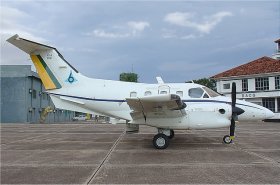 |
Thestylish looking Xingu combined the Bandeirante's wing and engines with an all new fuselage, but was only produced in small numbers. It flew for the first time in 1976, with a production aircraft following in 1977. The major customer for the Xingu I was the French Airforce, with a total order for 41 (for aircrew training and liaison duties for the air force and navy), which accounted for almost half of all EMB121 production.
Derivatives of the Xingu design including the original EMB120, the Araguia, a commuter airliner which would have seated 25, and the EMB123 Tapajós. The Tapajós would have had more powerful 1120 shp (835kW) PT6A45 engines (which also would have powered the Araguia), increased wing span and a lengthened fuselage. A more modest development did enter production, the EMB121B Xingu II with more powerful engines, four blade props, increased fuel tankage and greater seating capacity courtesy of a slightly stretched fuselage. Similar in size, powerplant and performance to the Raytheon Beech King Air B200, the Xingu II made its first flew in 1981. Production ceased in August 1987 after 105 had been built. |
|
|
|
|
| Seating (normal) |
7 |
Max Takeoff (lbs) |
13,536 |
| Seating (maximum) |
9 |
Certified Ceiling (ft) |
26,000 |
|
| Engines |
2 P&WC PT6A42 |
To (Sealevel, ISA Temp) (ft) |
- |
| Output lbs ea. Flat Rating |
850 shp |
Landing Distance (ft) |
- |
| Maximum Mach No. |
- |
Max Range (fuel) (nm) |
1,230 |
| High Speed Cruise (Kts) |
465 |
Max Range (payload) (nm) |
880 |
|
| Flight Time 300nm |
- |
Flight Time 1000nm |
- |
| Flight Time 600nm |
- |
|
|
|
| External |
|
Internal |
|
| Length (ft) |
44.10 |
Length (ft) |
- |
| Height (ft) |
15.60 |
Height (ft) |
- |
| Span (ft) |
48.70 |
Width: Max floor (ft) |
- |
|
|
|
 |
|
 |
|
|
|