|
|
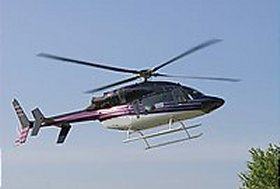 |
When Bell first looked at a twin engine version of its new 407 light single, the company originally anticipated developing the 407T which would have been a relatively straightforward twin engine development (with two Allison 250-C22Bs). However, Bell concluded that the 407T would not offer sufficient payload/range performance, and so began studies of a new light twin.
The result was the all new 427, which Bell announced in 1996. Bell's South Korean partner, Samsung builds the 427's fuselage and tailboom. Bell builds the 427's flight dynamics systems at Fort Worth in Texas, with final assembly at Bell's Mirabel, Quebec plant.
The 427 was the first Bell designed entirely on computer (including using CATIA 3D modelling). Compared to the 407 the 427's cabin is 13in (33cm) longer, largely of composite construction amd lacks the roof beam which obstructs the cabin on the 206 and 407.
Power is from two FADEC equipped Pratt & Whitney Canada PW-206 turboshafts, driving the composite four blade main rotor and two blade tail rotor (based on those on the OH-58D Kiowa and Bell 407) through a new combining gearbox. The main rotor's soft-in-plane hub features a composite flexbeam yoke and elastomeric joints, eliminating the need for lubrication and any form of maintenance. The 427's glass cockpit features an integrated instrument display system. |
 |
|
|
|
| Seating (normal) |
4 |
Max Takeoff (lbs) |
6,000 |
| Seating (maximum) |
7 |
Certified Ceiling (ft) |
18,900 |
|
| Engines |
2 P&WC PW206D |
To (Sealevel, ISA Temp) (ft) |
- |
| Output lbs ea. Flat Rating |
567shp |
Landing Distance (ft) |
- |
| Maximum Mach No. |
- |
Max Range (fuel) (nm) |
358 |
| High Speed Cruise (Kts) |
135 |
Max Range (payload) (nm) |
358 |
|
| Flight Time 300nm |
- |
Flight Time 1000nm |
- |
| Flight Time 600nm |
- |
|
|
|
| External |
|
Internal |
|
| Length (ft) |
35.80 |
Length (ft) |
6.40 |
| Height (ft) |
11.30 |
Height (ft) |
3.40 |
| Span (ft) |
7.70 |
Width: Max floor (ft) |
4.10 |
|
|
|