|
|
 |
|
 |
 |
|
|
|
|
|
|
|
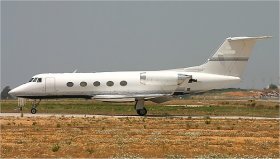 |
| The Gulfstream II and Gulfstream III are Spey powered developments of the original turboprop powered Gulfstream I. The Rolls-Royce Dart turboprop powered Grumman Gulfstream I enjoyed significant success as a large long range corporate transport, so the availability of an economical turbofan in the form of the Rolls-Royce Spey naturally meant that a jet powered successor was a logical development. Grumman launched such an aircraft, named the Gulfstream II (GII), in May 1965. While based on the original Gulfstream I, the GII shares the same forward fuselage and cross section, there are more differences than similarities. The most obvious difference is the two rear mounted Spey turbofans, others include a new swept wing and T-tail. A similar size fuselage to the GI seats 10 in a typical executive configuration. No prototype GII was built, instead the first to fly was a production standard aircraft, which first flew on October 2 1966. Certification and first production deliveries occurred in October and December 1967 respectively. |
|
|
|
|
| Seating (normal) |
12 |
Max Takeoff (lbs) |
65,500 |
| Seating (maximum) |
- |
Certified Ceiling (ft) |
43,000 |
|
| Engines |
2 RR Spey Mk 511-8 |
To (Sealevel, ISA Temp) (ft) |
5,700 |
| Output lbs ea. Flat Rating |
11,400 |
Landing Distance (ft) |
3,198 |
| Maximum Mach No. |
0.85 |
Max Range (fuel) (nm) |
3,178 |
| High Speed Cruise (Kts) |
480 |
Max Range (payload) (nm) |
2,711 |
|
| Flight Time 300nm |
1 + 3 |
Flight Time 1000nm |
2 + 43 |
| Flight Time 600nm |
1 + 53 |
|
|
|
| External |
|
Internal |
|
| Length (ft) |
79.90 |
Length (ft) |
33.90 |
| Height (ft) |
24.50 |
Height (ft) |
6.10 |
| Span (ft) |
68.90 |
Width: Max floor (ft) |
7.30 |
|
|
|
 |
|
 |
|
|
|